

NLP 2.0: The Magic is You (and the Matrix Explains It)
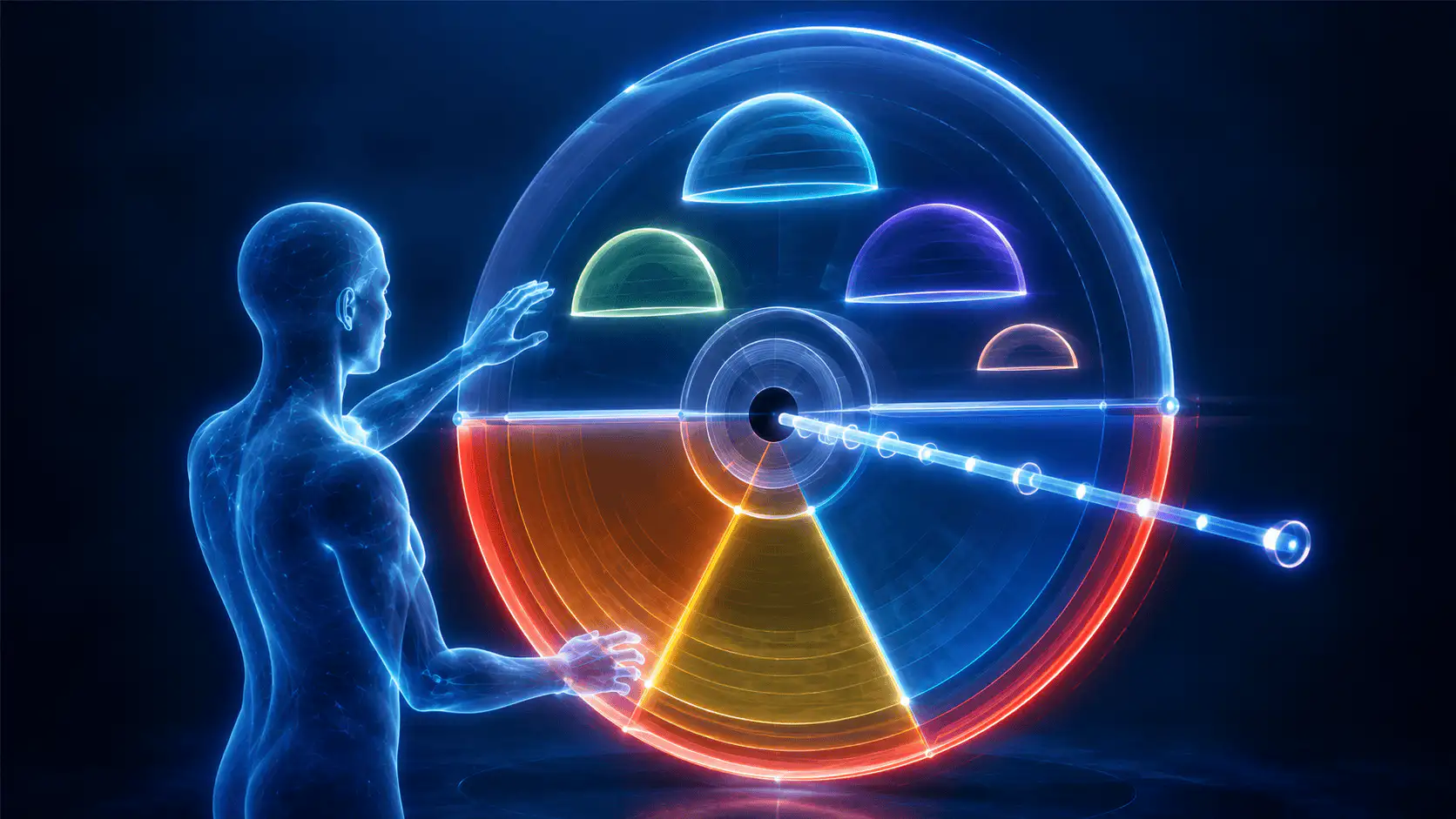
“NLP doesn’t work. You work. NLP just explains perfectly how you work.“
This sentence, spoken by the New Zealand practitioner Richard Bolstad, has the merit of setting the record straight. For too long, Neuro-Linguistic Programming has suffered from a controversial reputation, often associated with promises of “magic pills,” therapeutic pyrotechnics, or miracle techniques. However, if we return to its very essence, NLP was never intended to be a magic wand. It is fundamentally an approach based on observation and modeling.
The goal is not to blindly apply a technique to a passive individual, but to understand the structure of subjective experience. When a person manages to overcome an obstacle, it is not the technique that “worked,” but rather the person’s own neural networks and resources that reorganized themselves. The practitioner is only there to provide the map that helps the client navigate their own territory.
Toward an NLP 2.0: Moving Beyond Old Maps
This is where the need for an NLP 2.0 becomes apparent. Historical models, taught since the 70s and 80s, were excellent maps for beginners. The famous Logical Levels model by Robert Dilts, for instance, offered a brilliant pedagogical structure to understand how our beliefs influence our capabilities and behaviors.
But every map has its limits. If you use the London Underground map (perfect for navigating underground) to walk through the city streets, you will quickly become disoriented, because it deliberately simplifies and distorts reality. Similarly, faced with the complexity of the human being, a strictly linear and hierarchical structure shows its natural boundaries, particularly when it comes to addressing profound questions of identity.
Human beings do not always function in a top-down cascade. Sometimes, a change in environment or a simple physical action profoundly alters our beliefs. The NLP 2.0 we are calling for is a humble, collaborative, and “open-source” approach, one that is willing to question its own dogmas to better align with the living reality of experience.
The Matrix of Experience: The Tool of Embraced Complexity
The Matrix of Experience fits perfectly into this paradigm of systemic modeling. It does not reject the contributions of the past; rather, it extends them to capture dimensions that linear models could not represent.
To explain how you work, the Matrix proposes a dynamic cartography that finally does justice to our complexity:
-
The end of fixed identity: The Matrix replaces the concept of a single, monolithic identity with that of multiple and contextual identifications. You are not defined by a rigid label; you navigate between different roles (parent, professional, creative), each with its own skills, behaviors, and worldviews.
-
Dynamic circularity: Instead of a hierarchy where one level “drives” the others, the Matrix observes a circular system. Our actions (Doing), our mental maps (Knowing), our skills (Know-How), and our emotions mutually and continuously influence each other in all directions.
-
The generating role of Context: The environment is no longer relegated to the “bottom” of the pyramid. It becomes the encompassing framework that generates, values, or represses certain identifications.
-
The temporal dimension: Identity becomes a narrative thread, a trajectory connecting our past (retrospective), our present (lived), and our future (prospective), piercing through our system from end to end.
You Are the Author of Change
NLP 2.0, equipped with the Matrix of Experience, invites us to a revolution of humility and effectiveness. There is no savior, and there is no miracle protocol that will “fix” broken mechanics.
There is only you, an extraordinarily complex system, rich in multiple identifications, evolving within a given context. The Matrix is the next-generation compass that allows us to observe, model, and orchestrate this richness from a space of reflective awareness (the Meta space). NLP explains, the Matrix maps, but at the end of the day, it is always you who does the work.