

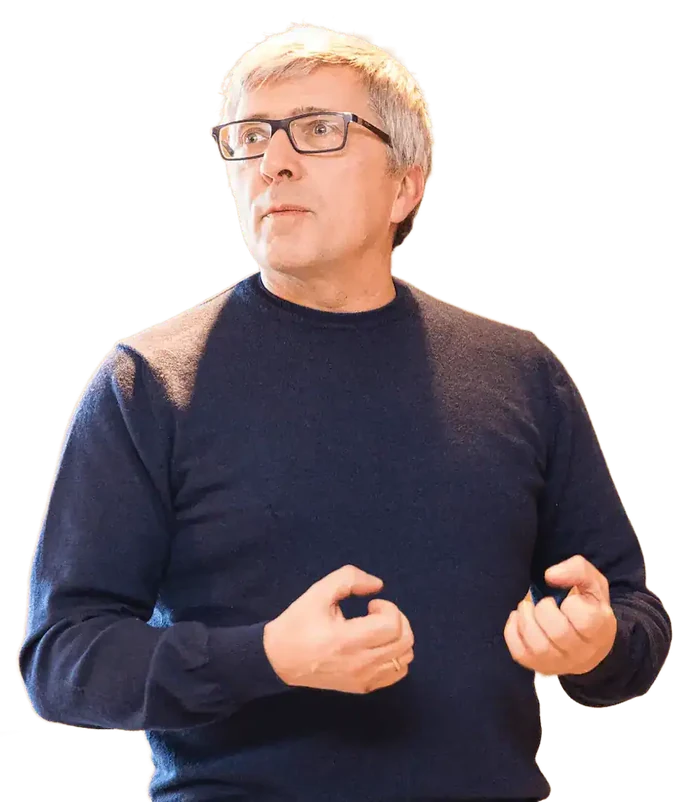
Christian Vanhenten
I did not find answers. My childhood came without an instruction manual. What it gave me instead was a fierce wish to understand how people get themselves out of things.
That question has kept me busy for more than fifty years, and it has taken me through several fields: aikido, engineering, coaching, and eventually modeling. What I found along the way is not a recipe. It is that the way someone does a difficult thing well has a structure, and that a structure can be handed on.
What the engineering was for
I trained as an engineer and spent years in information technology, which is not the obvious route into working with people. It turned out to be a useful one.
An engineer is trained to ask how something works rather than what it means, to look for the mechanism rather than the explanation, and to distrust an account that has never been tested. Those three habits are exactly what modeling requires. When someone tells you how they do what they do, the account is often sincere and rarely accurate — and knowing that is a technical instinct before it is a psychological one.
What the practice was for
Fifty years of aikido, a dojo founded in 1997, thirty years leading teams, and twenty-five years spent examining the structure of human experience.
The aikido matters here for one reason, and it is not the martial art. Among people who practise it, some see their daily lives change — how they handle a confrontation, an argument, a provocation — and others, equally diligent, see nothing change at all. That gap is what turned me into a modeler. Not what does this art teach, but what do the first group do that the second group does not. The answer became AikiCom.
The teams matter for a different reason. Thirty years of watching competent people fail to transmit what they were good at is a long apprenticeship in the problem this site is about.
How AikiCom was born
The turning point came in 1998, when I met Stephen Gilligan: I saw the link between aikido and NLP, and the idea of modeling aikido was born. Years of aikido practice suddenly found their place in the rest of my path. The bodily dimension of the art, and the ethics beneath it, came to complete what I had learned in the field of personal change. AikiCom is the product of that meeting: a model of aikido practice, built to be applied outside the dojo.
In the early 2000s, I trained with Stephen Gilligan in Ericksonian hypnosis. It was there that he recognized my work as an aikido teacher.
Christian Vanhenten is a talented aikido teacher, especially in the way he applies it to the challenges of communication. He has offered sessions during my seminars, and the participants greatly appreciated his teaching. His ability to highlight the mind-body connection and harmony as the foundation of effective communication is remarkable.
— Stephen Gilligan, PhD, psychologist, Ericksonian hypnotherapist, developer of Generative Trance and Generative Coaching, author of The Courage to Love (translated from the French version)
In 2009, I joined the board of directors of Aiki Extensions, an American association that develops the applications of aikido outside the dojo. There I contributed to the International Aiki Peace Week, which invites dojos around the world to centre their practice on peace for one week. In 2011, I chose to devote myself full time to AikiCom, training and coaching. Since 2013, I have contributed to the Peace Dojo International network; the Kimochi Dojo in Namur, where I teach, was certified as a peace dojo in 2014. In 2016, I founded the Applied Aikido association, a network of peers who develop the applications of aikido to everyday life: at home, at school, at work.
Where the work has landed
Training and consulting for institutions that do not have much patience for theory: the European Commission, the Belgian Red Cross, ING, Deloitte University, AT Kearney, the Université de Paix. Two AikiCom instructors trained in Pennsylvania. Fourth dan, Aikikai Tokyo.
And three books: one on facing conflict without fighting or fleeing, one on the Experience Matrix, and one in progress on the VOCAL model.
Why this site exists
Because modeling is the part that rarely gets taught. Fields that live on models tend to teach the models and drop the operation that produced them, which leaves practitioners as consumers of other people’s work. I would rather hand on the operation.
That is what you will find here: the method, the models it has produced, and the reasoning behind them.
I came to modeling through a field that had made it its founding method before turning towards its tools. That is a circumstance, not a subject. In French, the rest of that work lives at atelierpnl.eu, and the martial side at aikicom.eu.