

What Will Make the Difference in the Age of AI
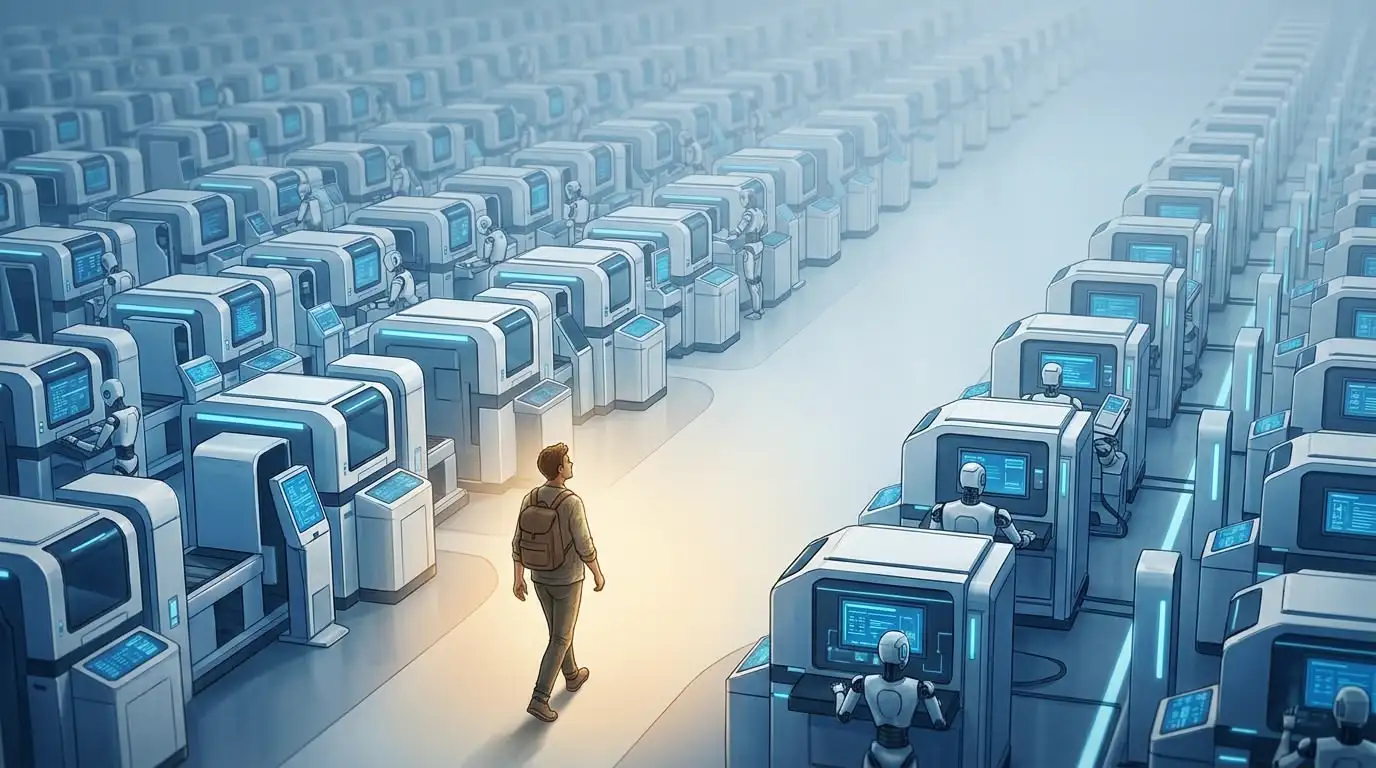
It is everywhere
In late 2022, an artificial intelligence tool capable of holding a conversation was made available to the public. Within two months, it had around 100 million users. No consumer technology had ever spread so fast. The telephone had taken several decades to reach such a number.
Since then, these tools have found their way into everything: phones, office software, search engines, messaging apps. Artificial intelligence, or AI, here refers to programs that can produce text, images or analyses from a simple written or spoken request.
Knowledge is becoming accessible to everyone
For centuries, knowing was a privilege. It took books, schools, years of study, access to experts. Whoever knew had an advantage.
That is no longer the case. In a few seconds, an AI explains a law, summarizes a book, proposes a training plan, corrects a text, compares options. It does so for free or for a few euros a month, at any hour, in most languages.
Pure knowledge, that is, information one can recite or look up, is becoming an abundant resource. And what is abundant loses its value. Knowing the answer no longer sets anyone apart, since everyone can get it.
Knowing is not doing
There is, however, a gap that AI does not close. It is the gap between knowing and doing.
You can know that you should stay calm in a conflict, and lose your temper. You can know the rules of a good presentation, and freeze in front of the audience. You can have read everything there is on motivation, and put off an important project until tomorrow, every single day.
The information is the same for everyone. The results are very different. What makes the difference lies inside the person: their state at the moment of acting, what they notice, what they say to themselves, what they feel.
An AI can give the right advice. It cannot live it for us.
What AI does not do for us
The more AI takes over the work of production, the more certain human capacities stand out:
- keeping one’s attention on what really matters;
- judging a new situation, without a ready-made template;
- regulating one’s emotions, that is, not getting carried away by fear, anger or discouragement;
- deciding under pressure;
- staying motivated over time.
Relational quality deserves a place of its own. Creating a relationship is not enough. It also has to be maintained, day after day, at work as in private life. This rests on two specific capacities:
- empathy: perceiving what the other person is going through and understanding their point of view, without necessarily sharing it;
- assertiveness without aggression: saying clearly what you think, what you want or what you refuse, while respecting the other person.
A solid relationship depends on this balance. You listen to the other person, without erasing yourself.
Another capacity lies beyond the reach of AI: intuition. Intuition is the ability to sense the right direction before being able to explain it. It draws on a diffuse knowledge, made of thousands of lived experiences. This knowledge is stored in the body as much as in memory.
Take a teacher who senses that a pupil is not doing well, even though the pupil says otherwise. Nothing in the pupil’s words suggests it. Yet something in their gaze, their posture or their silence alerts the teacher. The teacher is right.
AI works differently. It works from the information it has been given. It perceives neither the atmosphere of a room, nor the tone of a voice, nor what goes unsaid. When a piece of information is missing, it still produces an answer that sounds plausible, even if it is wrong. Humans, for their part, can rely on what they perceive in the moment and on what they have lived through.
Intuition is not a gift reserved for a few. It can be developed. It takes accumulating experience, paying attention to one’s inner signals and learning to tell a reliable intuition from a mere fear or a wish.
Above all these capacities, there is one that makes them possible: meta-competence. “Meta” means “above”. Meta-competence is the ability to understand the structure of what one is living through, while living through it, so as to be able to change course if necessary.
Take a discussion that is getting tense. A person notices that their inner voice is racing and that their shoulders are tightening. They then choose to slow down before answering. Without meta-competence, we are at the mercy of our reactions. With it, we can adjust them.
These capacities cannot be bought or downloaded. They are developed. They rest on what each of us does inside ourselves, often without knowing it.
Inner experience has a structure
What we live through inside is not a blur. It is a fairly precise organization, one that can be described. We speak of the structure of experience. It includes what one notices first, the images that come to mind, the inner voice that comments, the sensations in the body, and the order in which all of this happens.
Take two people who have to speak in front of a group. They have the same text and the same preparation.
- The first imagines stern faces judging her. Her inner voice keeps repeating “you’re going to get it wrong”. Her stomach tightens.
- The second imagines she is talking to a few interested friends. Her inner voice says “here’s what I want to share”. Her breathing stays full.
Same situation, same knowledge. Two different inner structures, and two different results.
The good news is simple. A structure can be changed.
Changing your inner experience
Changing your inner structure can be learned. It consists in acting on the elements that make it up:
- shifting your attention;
- turning an image that paralyzes into an image that supports;
- changing the tone of your inner voice;
- deliberately getting back into a useful state.
Everyone already has resources. A resource is a capacity or a state that one possesses in a given context. It is, for example, the calm you have when gardening, the confidence you have with those close to you, the concentration you find in an activity you love. The work often consists in making these resources available where they are needed.
Another path is observing those who excel. When a person does something remarkably well, their success also has a structure. It can be described precisely, then learned. This work is called modeling: describing how a success works from the inside, so as to make it transmissible.
A new priority
For a long time, work on inner experience served mainly to repair: overcoming a fear, getting past a block, easing a difficulty. That work remains valuable.
But our times ask for more. The challenge is no longer only to correct what is wrong. It is to actively develop our resources, our aptitudes and our personal skills. It is about learning to adjust our inner state to what each situation truly calls for.
AI can provide the knowledge. Human know-how remains for each of us to build. In a world where answers are available everywhere, the difference will come down to the ability to act with accuracy, presence and clarity. That ability can be worked on, and it is worked on from the inside.
Key takeaways
- Pure knowledge is becoming abundant: AI makes it accessible to everyone, in a few seconds. It is no longer enough to make the difference.
- Knowing is not doing: the gap between the two plays out in one’s inner state at the moment of acting.
- Relational quality is created and maintained: it rests on empathy and on assertiveness without aggression.
- Intuition draws on a diffuse, lived and embodied knowledge, as well as on the signals of the moment. It allows choices where AI lacks information. It develops through experience and attention to oneself.
- Meta-competence is the ability to understand the structure of what one is living through in order to change course if necessary. It makes all other skills possible.
- Inner experience has a structure: attention, images, inner voice, sensations, and their order.
- This structure can be changed: one can adjust one’s state to what the situation calls for.
- Everyone has resources that they can make available where they need them.
- Modeling describes the structure of a success in order to make it learnable.
- The priority is shifting: it is no longer only a matter of solving problems, but of developing what makes us fully human.
About the author
Christian Vanhenten is a trainer and coach. For nearly thirty years, he has studied the structure of human experience and modeled the skills of those who excel. He passes on this approach so that everyone can learn to observe and change their own experience.
A practitioner of aikido for more than forty years, he created AikiCom, a conflict management method that applies the principles of this martial art to relationships: welcoming the other person’s force, taking a position without aggression, redirecting rather than opposing.
He works with individuals and groups who want to develop their inner resources, their relational quality and their meta-competence.