

The Inverted World: What If the Matrix Had Come First?
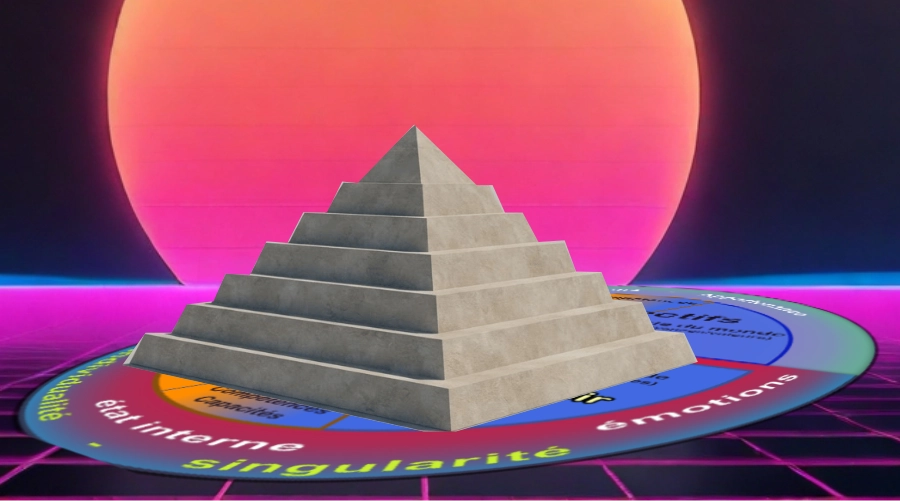
Over the past few weeks I have received several readers’ responses to my book, from NLP trainers and master practitioners. Serious responses, carefully argued, taking the time to say why they don’t follow. That is not the kind of mail you complain about: you have to have read a book to object to it.
First, a mea culpa. I did initially present the Matrix as the model that was going to replace the logical levels. That put people’s backs up, and I understand why. It took me six months and about fifteen people telling me the same thing before I heard it, after which I rewrote whole sections. The framing changed.
The comparison stayed, for a reason that isn’t mine to control: a model that extends another one invites comparison. That is a property of the situation, not an author’s intention. Even if I had refrained, others would have made it. Others do make it. One reader who had gone through the London Underground metaphor and the Newton-and-Einstein analogy — two passages that say extension, not replacement — still answered me on the ground of comparison.
There is nothing to be done about that. So I may as well own it, and turn it around.
Which is why I felt like taking a detour rather than answering point by point. I imagined the situation reversed. A world in which the Experience Matrix had been the basic model of NLP for forty years, taught everywhere, handed down from one cohort to the next as the foundation nobody questions any more. And in that world, I publish a book proposing something else: a vertical stack of six levels, environment at the bottom and spirituality at the top, which I call the logical levels. A new model, simpler, easier to draw on a whiteboard.
What makes the exercise interesting is that it catches a number of arguments from behind. Some things are said very comfortably in one direction and become hard to sustain in the other. That a model is accessible, for instance. That it is already here. That thirty years have been invested in it. These arguments don’t change nature when they change sides, but you see them better once they are turned around, and that is about the only thing I am after here.
The letter that follows is therefore written by a trainer and master practitioner from that world, who has just closed my book and picks up a pen to tell me what he thinks of it. His first name is entirely invented — partly because the anonymity of my real correspondents matters to me, and partly because this letter has no reason to exist. It is a fiction. Nobody wrote it, and it would be unfortunate if anyone went looking for its author.
I leave you with Étienne.
Dear Christian,
I read your book over two evenings, which should already tell you something: it is not that often a methodology text keeps me awake. You write well, you argue cleanly, and the question you raise is a real question. In the forty years we have been teaching the Experience Matrix, nobody had seriously attempted to propose anything else, and it took a certain nerve to try. I say this at the outset because what follows is long, and I would not want the length to read as irritation. It is the opposite: one does not argue for fifteen pages with work one finds negligible.
You propose to replace the figure of the Matrix with a vertical stack of six levels, environment at the bottom and spirituality at the top, and you call this the logical levels. You claim two virtues for the model, simplicity and linearity, and that is where I would like to start, because I believe those are the two places where your book most needs careful discussion.
Simplicity first. You are right that the Matrix demands an effort to learn. It demands a great deal, and I measure that every year in training. But a simple model of a complex object does not make the object simpler. It makes the model easier, which is not the same thing, and it moves the complexity elsewhere: onto the practitioner, who will have to make up in session for everything the diagram fails to tell them. The Matrix asks for its effort once, at the moment of learning it. The staircase asks for its effort at every session, without warning, and the practitioner does not even know they are paying. Bateson set the criterion and it still holds: a model must possess at least as much variety as the system it claims to govern. Six boxes for an experience that has more do not simplify that experience, they force it. Every phenomenon without a box will go into the nearest one, and that is where the mechanism becomes expensive: the practitioner will believe they have understood it when all they have done is file it.
Linearity next, which strikes me as the more serious matter. You hold that each level organizes the one below it, and that a change made at the top radiates downward. I see three costs to that decision.
The first is that the asymmetry is asserted with nothing to support it. If the return path exists — and it does, you acknowledge it yourself in several places — then your hierarchy is a loop you have cut at a chosen point, and the only justification for the cut is that it lets you draw the loop straight.
The second cost is more awkward, because it touches how your model defends itself. If a change of belief produces nothing, you invite the practitioner to move up a floor. If work on identity doesn’t hold, if it isn’t enough to resolve the problem, you invite them to move up again. An arrangement in which every failure confirms the hierarchy that caused it is not a solid arrangement. It is an unassailable one, which is precisely the opposite of solidity.
The third cost is terminological, and I would not mention it if it had no consequences. By calling them “logical,” you summon Russell, and in Russell a higher type is a class that contains its members. The test is then easy to run, and I have to say the vertical stumbles in two distinct places rather than in general. Well spotted, first of all, to have placed capabilities below beliefs: there is a genuine step. Except that between knowing and know-how there is only ever a restriction within a single register, know-how being no more than knowledge applied. You do not change logical type in moving from one to the other; you move within the same one. As for behavior, it is in no sense a subclass of beliefs. “Belief” and “behavior” are two aspects of one experience, not two sets nested inside each other. What you have built, strictly speaking, is a classification by prototypes, which is perfectly respectable and clinically useful. But then you must stop calling it logical, and give up at the same time on deriving downward causality from it — because it was the word “logical” that made that causality look necessary.
There is one passage in your book that held me longer than the others, and I want to say this without malice, because I see an honest gesture in it. You sense that things are missing from your vertical: temporality, the interrelations between non-adjacent levels. So you propose to add perceptual positions and the timeline to your six levels, and you call that assembly the unified field. The move is legitimate, and I would have made it too in your place. Only it says something about the starting point. If temporality and the relations between levels had had a place among the six levels, there would have been nothing to add to them, and the addition would have had neither object nor name. The unified field, then, is not a property of your model; it is what makes it sufficient — and the name you give the operation ends up naming, without your intending it, the list of what was missing. You need three models to cover what the Matrix holds in a single figure. A model that has to be completed by two others in order to become sufficient is not a complete model with some comfort added; it is a partial model whose gaps have been given a name.
Now to your identity floor, because that is where the real difference between our two ways of seeing plays out. As I read, I tried asking myself what goes in there. “I am reliable” is a belief about oneself; it belongs to the floor below. “I am a developer” states membership in a class of people. “I am what I do” points to behavior, “I am my skills” to know-how. Every identity statement I have been able to test is borrowed from another register. The floor has no content of its own. It only has content on loan.
And there is something more troubling for a model that claims our tradition: identity is first of all a nominalization. To make it a level is to reify a nominalization — to do exactly the opposite of what the Meta Model does, whose whole function is to open a nominalization back up and recover the process it froze. What I fear, very concretely, is that practitioners trained on your vertical will spend their time arbitrating boundaries with no clinical stake at all, boundaries produced by the way the model cuts things up rather than by the client’s experience. When the client says “I am…,” is that a belief or an identity? A capability or a behavior? The Matrix settles those debates through emergence: identity is what appears from the meeting of all the spaces without belonging to any of them, and that is why it figures there as that central point with no surface, where nothing can be placed. It is not a box left empty for want of rigor. It is the logical consequence of emergence, and it also explains why every identity statement you file on your fifth floor is borrowed from somewhere else. So you face a dilemma: either you redistribute everything into beliefs, and the floor becomes useless, or you keep it and don’t know what to put in it. Or else you put anything in it — roles, functions, titles, qualities, diplomas, occupations.
You will reply, and you write as much, that your practice with that floor is far richer than the diagram suggests. You use the image of the many-faceted diamond; you quote a phrase I found beautiful, being unique like a few others and like everyone else. I believe you without reservation, and that is exactly what worries me. All of that is in your practice, and none of it is in your diagram. A model is what remains when its author is not in the room. If your virtuosity compensates for the vertical’s silences, then they are indeed silences, and those who learn your model without having your talent will inherit six boxes without inheriting what you put in them.
Then there is the question of environment, which you place right at the bottom, and which is not in any case a lower logical level, whatever the drawing suggests. Context does not undergo; it encompasses. It precedes the person, it runs through them, it configures what is possible for them and even the categories in which they think themselves. An individual is a holon, a whole that is at the same time part of a larger whole, and the Matrix says this by its very shape, making context the outer circle. A position in a diagram is always a statement. Putting context at the bottom of a pyramid where causality descends is to maintain that social and relational determinations are the least determining — which I have never heard you maintain and which nobody would defend explicitly. The model says it in your place, silently, every time a practitioner draws it on a whiteboard. I see an ethical consequence there that I am certain you do not want: if context is at the bottom and identity at the top, every block refers back, in the last instance, to the inside of the person. Your vertical makes it structurally unthinkable that an external constraint might be the cause rather than the symptom. It individualizes by construction, without anyone having decided so.
Which brings me back to a sentence in your own book, where you write that real transformation comes not from the model but from the quality of the relationship. I am as convinced of that as you are. But I then find it strange to defend an architecture in which the relationship appears nowhere. If the relationship is what does the work, it has to be in the model and not only in the convictions of whoever uses it. The Matrix carries it in two places: in the context that encompasses, and in the Identifications space, intersubjective by definition. Your vertical has no room for anyone else.
I come to the absences, and I list them because that is where my reading was most attentive.
Internal states and emotions first: neither behavior, nor capability, nor belief, nor identity, nor environment. No box. Yet emotion occurs at the interface of outside and inside, it works as a sensor for context, it is often the first information available — the one that indicates a direction before you know what the matter is. The Matrix devotes a whole ring to it, at the intersection of context and inner life. In your vertical, emotions have not been moved. They have disappeared, and they have disappeared from a model that claims to map subjective experience.
Then meta-programs and meta-states. A staircase has no center; it has a bottom and a top, and so it offers nowhere to house what operates on the other registers: the filters through which someone sorts information, the states that bear on other states. These operators do not form an extra level you could slip between two steps. They apply to all levels, and that is in fact what defines them. A vertical architecture has no transversal position. What disappears there is reflexive awareness — and with it the place from which the practitioner works.
The temporal dimension is, to my mind, the gravest loss. You file time under environment, along with the where and the when, which makes it a circumstance. But time is not a circumstance of identity; it is its condition. An identity is not a state you observe at an instant. It is a continuity maintained through change — what Ricœur called ipseity, to distinguish it from sameness: not what stays identical, but what keeps being itself while changing. Damasio anchors the sense of being oneself in duration in the same way; an instantaneous emergence would be too fleeting for anything to be felt of it at all. The Matrix makes time an axis, its third dimension, the past behind and desire ahead. And notice the effect this has back on your own model: deprived of time, your identity floor is forced to become static. It can no longer be a process; it has to be a state. Geometry has decided ontology, and I do not believe that is what you wanted.
One last point, which on its own may sum up your book. A capability is what appears when a behavior meets a map of the world that makes it possible. The Matrix places it at the intersection of two spaces; you make it a box. That is the move I find in every chapter: wherever the Matrix shows something born of the meeting of two spaces, you add a floor. Emergence bothers you because it doesn’t stack, so you convert it into a level, and each conversion strips it of what made it what it was.
You care a great deal about the stability of identity experience, and you are right to. We remain someone through our contradictions; that is an observation before it is a thesis. But where does that stability come from? In your vertical, from a level that holds it — which presupposes a substance and leads you straight back to the essence you say you refuse. In the Matrix, it comes from the continuity of an emergence, something that recomposes itself endlessly and whose permanence is made by the narrative. That, I believe, is the only way to account for what you observe — stable without being immutable — without reintroducing a fixed thing at the top.
I don’t want to close this letter without acknowledging what seems true in your undertaking. As a way into the field, a staircase of six steps is a workable door, and an excellent first vocabulary: you can draw it in thirty seconds, learn it in an evening, and use it the next day. I see very well why your readers find relief in it. It is only that accessibility should not be confused with accuracy. The history of science is full of systems kept for a long time because they were convenient: Ptolemy remained easier to calculate than Copernicus for close to a century, which never made him a better description of the sky. What I count, closing your book, is eight things given up against a single gain. Emotions, the Meta space, the axis of time, the emergence of capabilities, the encompassing place of context, the circularity of influences, the multiplicity of identifications, the relation to others — against ease of memorization. And the gain is itself fragile, since everything taken out of the model will have to be put back by the practitioner, at their own expense and without warning.
You may tell me that I am defending a model I have invested thirty years of my life in, that I have trained hundreds of people in this figure, and that my resistance says more about me than about your work. That is entirely admissible, and I cannot refute it from the inside: nobody is a good judge of their own attachments. But it answers none of the eight objections. So tell me instead which of those eight renunciations you own, and why. That is the conversation I would like to have with you, and I would far prefer it to an exchange of courtesies.
At your disposal to discuss it, afternoons around five.
Warmly, Étienne