

The Experience Matrix
A map of what a person is made of at a given moment, and of where a difficulty actually sits.
ToolIdentity & experience
experience-matrix-images
What it makes analysable
“I’m just not that kind of person.” Anyone who works with people has heard that sentence, and it usually ends the conversation. It is offered as a fact about what someone is, and there is nothing to be done with a fact.
The Matrix takes that sentence apart. It replaces the question “who am I?” — which rarely leads anywhere — with “how do I identify, in this context?” The first asks about an essence. The second asks about a relation, and a relation can change.
More usefully, it locates where a difficulty actually lives. Someone whose behaviour has moved on while their beliefs have not. Someone whose emotional habits belong to a version of themselves they have otherwise left behind. Someone who knows exactly what to do and does not do it. These are not contradictions or failures of will. They are spaces out of step with each other, and once you can see which ones, you know where to work.
The model
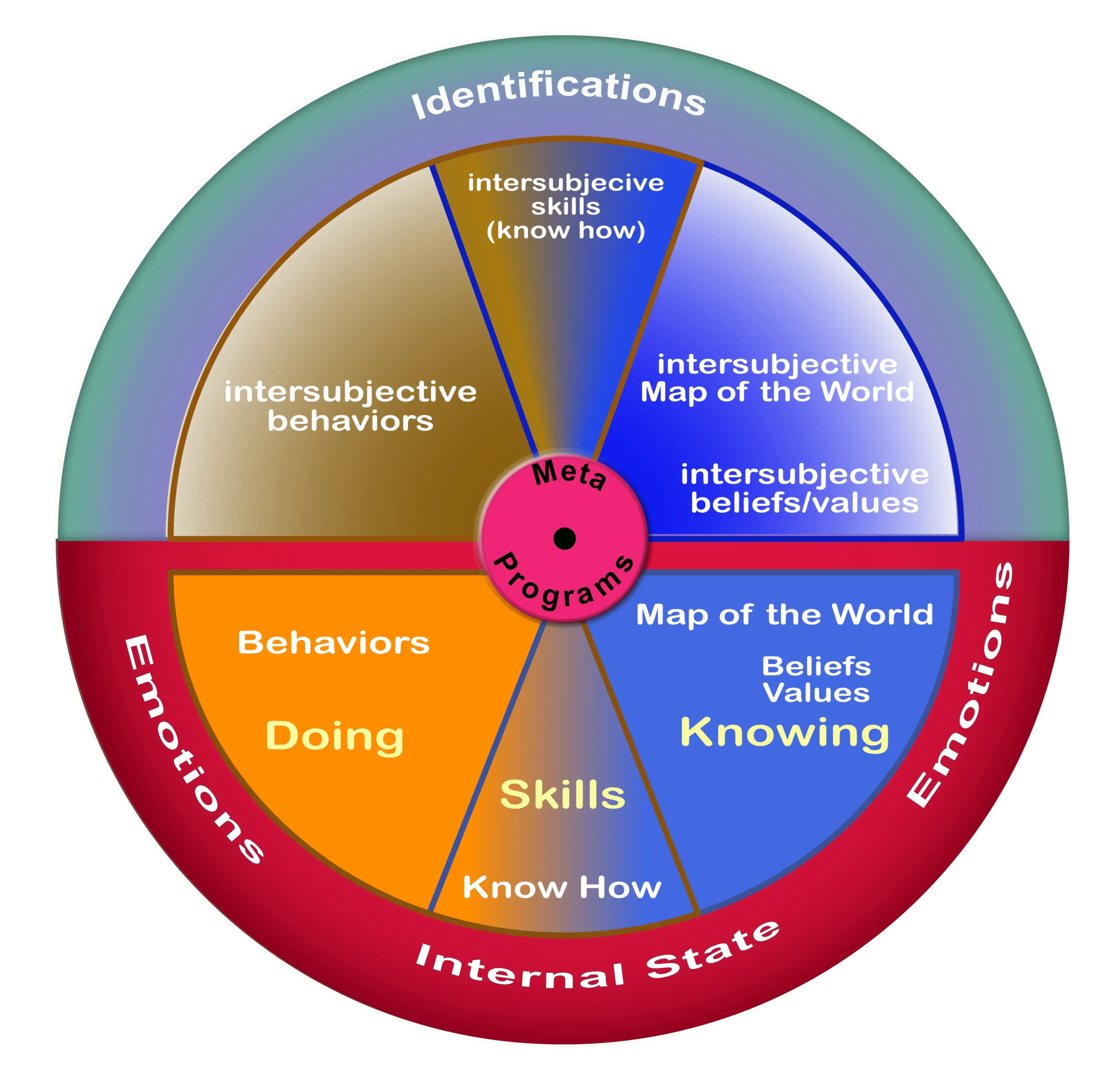
The Matrix describes seven spaces of experience, arranged as concentric circles rather than as a ladder. Nothing sits above anything else, and each space influences the others rather than commanding them.
- Context — not a passive backdrop. It generates, it does not merely surround.
- Singularity — holding three spaces: Doing, Knowing and Know-how.
- Emotions — internal state, treated as a space of its own.
- Identifications — plural and contextual, never a single fixed identity.
- Meta — the space from which the rest can be observed.
Each space can operate at one of four levels: Reactive, Adaptive, Integrative, or Transcendent.
And here is the part that changes practice. Problems rarely sit inside a single space. They emerge from desynchronisation between spaces: behaviour running at one level while belief runs at another, emotional patterns that have not caught up with how a person now identifies. That is why working harder on the wrong space produces so little.
How it was modeled
The Matrix did not begin as a theory. It began as a repeated failure in practice, over twenty-five years: work that stalled whenever it reached the question of who someone believed themselves to be.
The existing maps described experience as a hierarchy, with identity near the top. That arrangement works until someone reaches it, at which point it hands them a reason to stop. If the obstacle is what I am, there is nothing left to adjust. The map itself was producing the paralysis.
What was extracted, case after case, was that people do not have one identity that occasionally shifts. They identify — as a professional, as a parent, as the person who never finishes anything — and they do so differently depending on where they are. Identification is a verb. That single change of grammar turns a wall into a variable.
The seven spaces came later, from asking what else was being smuggled into “identity” that deserved a place of its own. The four levels came from noticing that the same space behaves very differently depending on how it is operating.
Going further
The book on the Matrix, The Experience Matrix — Extending the Logical Levels Model, came out in English on August 3, 2026, in paperback and Kindle, with protocols, case studies and questioning techniques for each space and for the connections between them. It also exists in French.
These articles take up the model from different angles:
- A New Cartography of Human Experience — the full presentation: why the pyramid runs out, how the spaces fit together, and what the model makes possible in practice.
- The Identity Trap in Traditional NLP — why identity-level work seemed so hard, and what changes when “I am” becomes “I identify as”.
- From the Identity Level to Identifications — the longer argument, with Durkheim, Heidegger and Damasio converging on the same point from three directions.
- From Environment to Context — Umgebung and Umwelt: why context encompasses the system instead of sitting at the bottom of it.
- Wisdom Lives in Widening Circles — an independent study of wisdom that lands, without meaning to, on the Meta space and the space of identifications.
Origins
The Matrix extends a well-known model of logical levels rather than replacing it: where that model maps the what of experience in layers, the Matrix describes the how — the relations through which a person keeps constructing themselves. It draws on Damasio on the felt body, Ricœur on the difference between sameness and selfhood, and Wilber on developmental levels.
Related models
AikiCom describes a sequence unfolding in time; the Matrix maps a state at a moment. PKMind is an application of the Matrix to a specific field: what happens inside someone managing what they know.