

From Critique to Redefinition: Identity as Constructive Narrative
A necessary critique, and an insufficient one
For years I criticized, with some vehemence, the identity level as it is generally presented in NLP. That critique was deliberately provocative, and it pointed at one fundamental problem: the concept of identity remains badly defined there, in a way far too vague to be rigorous.
In conventional trainings, identity is presented as a “higher” level determining all the others, without anyone ever spelling out what it covers. Is it an essence? A role? A collection of traits? That conceptual imprecision leads to approximate interventions and sharply limits therapeutic effectiveness.
But criticism without a constructive alternative stays sterile. My thinking gradually moved toward something more fruitful: rather than denouncing the identity level, redefine it.
Identity as narrative
Contemporary research in developmental psychology and in the philosophy of identity converges on a single understanding: identity is not a static given but a narrative we actively construct.
Several strands of work support that view.
Self-authorship: becoming the author of your life
Marcia Baxter Magolda’s work on self-authorship shows that psychological maturity consists precisely in developing “the capacity to internally define a coherent belief system and identity that coordinates mutual relations with others.” The process runs through three phases:
- Trusting your internal voice rather than reacting automatically to past conditioning
- Building an internal foundation by consciously combining your values, beliefs and commitments
- Securing that internal commitment against external pressure
The narrative construction of identity
Paul Ricœur, in Oneself as Another, draws a fundamental distinction between identity-idem (what stays identical) and identity-ipse (the maintenance of oneself through change). The second is built essentially through what he calls narrative identity: we become the story we tell ourselves.
That conception resolves the apparent paradox between permanence and change. Our past experiences are the raw material of our identity — facts we cannot alter. But the meaning we give those experiences, and the way we integrate them into our personal narrative, remains endlessly transformable.
Multiple identifications: past the illusion of unity
Work by Abes, Jones and McEwen on multiple identities shows that we do not possess one identity but plural, contextual identifications. Their model shows how our capacity for meaning-making determines the way we negotiate those multiple belongings.
This recognizes that human beings are fundamentally social, constructed in and through their relationships. We identify simultaneously with different groups, roles and archetypes, and that multiplicity is not a problem to solve but a richness to orchestrate.
The Experience Matrix as an instrument of precision
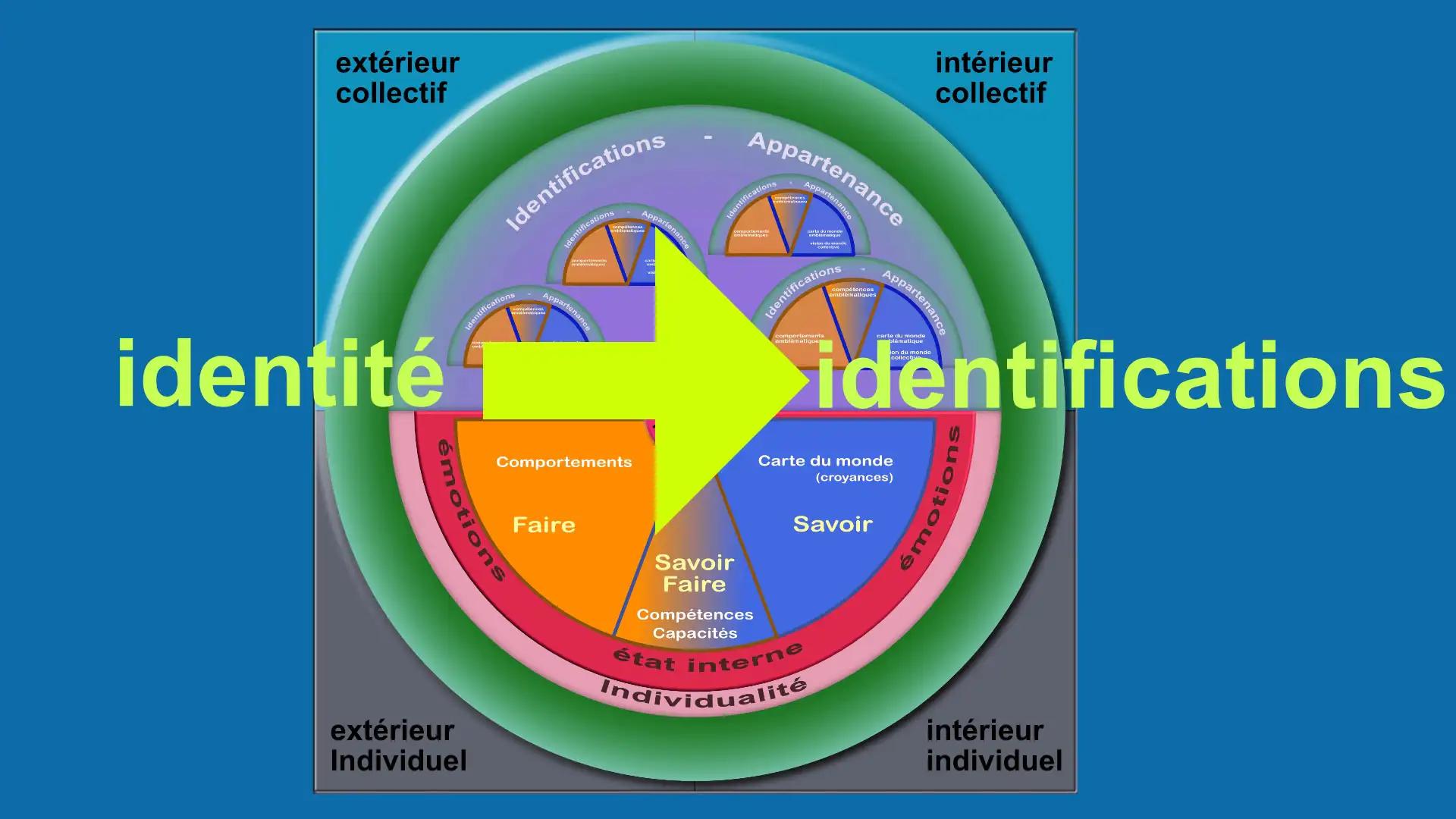
This conceptual redefinition finds its practical translation in the Experience Matrix, which repositions identity at the center as a temporal and narrative dimension while opening a dynamic Identifications space to carry the social influence specifically.
Within that architecture, the Singularity space works like a conductor: our personal history — the sequence of experiences we have lived and the way we have interpreted them — is the score. But this conductor has a remarkable property: he conducts the orchestra while writing the score at the same time. He does not merely follow an imposed melody. He composes his own music, harmonizing outside influences and modulating our identifications according to the personal narrative he is creating in real time.
Even with identity better defined, though, I still contest fundamentally that all these elements of our experience are organized in a linear and hierarchical way. The pyramidal arrangement is tempting because it is simple, but it turns out to be simplistic against the real complexity of psychic processes. Human experience runs on dynamic interactions and mutual influences far more than on top-down determinations.
Identifications rather than an identity
The upper half-circle of the Matrix holds our multiple identifications — the belongings that define us partially without confining us. The approach has several decisive advantages:
- Flexibility: our identifications can evolve, adapt to contexts, strengthen or fade
- Multiplicity: we can hold several identifications at once without contradiction
- Process: the emphasis falls on how we identify rather than on what we are
Bringing in the temporal dimension
Where the identity level has become an indistinct catch-all, and therefore unusable, the Matrix fully integrates the temporal dimension of identity construction. It recognizes that we are simultaneously:
- heirs to our past (our constitutive experiences)
- actors in our present (our current choices)
- creators of our future (our identity projects)
Recognizing intersubjectivity
The Matrix gives a central place to intersubjective behaviors and to the space of intersubjective knowledge, recognizing that identity is always built in relation to others. That dimension is entirely absent from the classic intervention levels, and without it the processes of change are hard to account for.
New levers for change
Redefining identity as constructive narrative opens practical possibilities.
Narrative intervention
Rather than trying to “change identity,” which stays mysterious, we can support the person in transforming their identity narrative. That means:
- exploring the possible versions of their story
- identifying the elements of continuity that hold coherence together
- finding new meanings in past experiences
- enriching the repertoire of available identifications
Exploring identifications
The Matrix makes it possible to examine in detail how a person constructs themselves through their multiple belongings:
- Which identifications are currently active?
- Which are nourishing, which are limiting?
- How do different contexts activate different facets?
- Which new identifications could enrich the person’s experience?
Developing self-authorship
By distinguishing clearly between the spaces of intervention, the Matrix makes it easier to develop internal authority:
- recognizing your own values as distinct from external expectations
- taking responsibility for your identity choices
- developing a flexible internal coherence
- consciously negotiating your identifications across contexts
Toward a constructive reconciliation
A rigorous redefinition of identity might well reconcile the approaches currently set against each other in the field of personal development and therapy.
For those who defend the logical levels, this conception preserves the founding intuition that identity occupies a particular place in the psychic economy, while giving it precise and operational content. It keeps the idea of a “meta” level without falling into the myth of an immutable essence.
For demanding practitioners, it answers the requirement of conceptual rigor by resting on solid research and offering precise intervention tools. It avoids the empty generalities of conventional personal development in favor of concrete levers.
For narrative therapists, it validates and enriches the narrative approach by integrating it into a broader systemic model that accounts for the complexity of psychic processes.
Leaving the vagueness behind
By redefining identity as the narrative we construct about our experience, we finally escape the vague generalities that too often characterize personal development. That conceptual precision is not an academic luxury but a practical necessity.
With this understanding, we have therapeutic levers of a new fineness. We can support people in the creative reappropriation of their own story, help them become the conscious authors of their existence rather than passive spectators of their fate.
Moving from critique to redefinition illustrates a more general approach: rather than discarding imperfect concepts, refine them until they become precise tools in the service of human transformation.
Identity, redefined as constructive narrative, offers a middle path between paralyzing determinism and the illusion of the blank slate. It recognizes that we are heirs and creators at once, constrained and free, unique and multiple within our shared humanity.