

From Phenomenology to Coaching: Three Worlds, One Structure
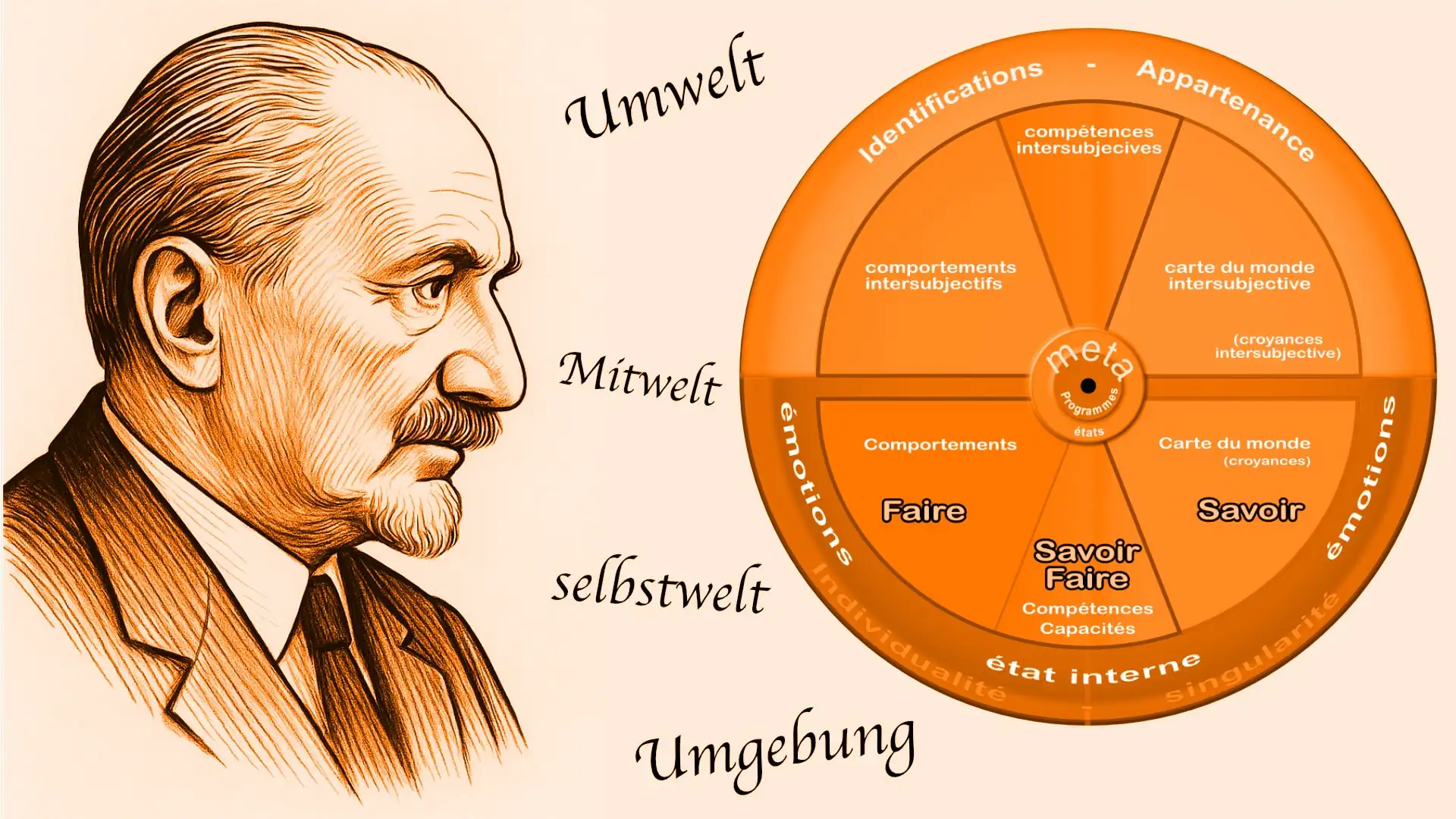
Phenomenology can look abstract at first glance, a set of difficult philosophical debates about the nature of existence and consciousness. Yet its concepts turn out to be remarkably usable in the consulting room. They give a practitioner ways to explore and understand a client’s experience that few other frameworks match.
Three of those concepts make the point well: Selbstwelt, Umwelt and Mitwelt, applied to the questions we ask in coaching. They also converge, closely, with the Experience Matrix.
Three dimensions for locating a client
Clients often arrive saying that something is out of joint, that they do not feel they are in the right place. To help them clarify that discomfort, it helps to organize the questioning around three dimensions drawn from phenomenology: the relation to oneself (Selbstwelt), to the surrounding world (Umwelt), and to others (Mitwelt).
Selbstwelt: the world of the self
What you are after: the client’s relation to themselves, their values, their deeper desires, their sense of who they are.
Questions to ask:
- What genuinely matters to you in your life?
- When do you feel most fully yourself?
- Which of your strengths, talents, or passions would you like to see more of in your life?
- When did you last feel in agreement with yourself?
Umwelt: the surrounding world
What you are after: how the client lives their daily context, their activities, their setting, their work.
Questions to ask:
- How do you feel in your current context: work, home, city?
- Which activities give you energy, and which drain it?
- Does your daily life reflect who you really are?
- Are there situations or places where you feel particularly at home, or particularly ill at ease?
Mitwelt: the world shared with others
What you are after: the quality of the client’s relationships, their sense of belonging, of being recognized and supported.
Questions to ask:
- With whom do you feel genuinely understood or accepted?
- Which relationships nourish you, and which weigh on you?
- Can you be yourself with other people?
- Are there people or groups where you would like to feel more at home?
Making sense of the answers
Organizing the questioning this way helps the client locate where the discomfort sits:
- an inner conflict (values, beliefs, emotional states)?
- a mismatch with their context?
- a difficulty in their relationships?
- some combination of the three?
A way to feed it back:
“Listening to you, it sounds as though you feel out of step with yourself, with what you do day to day, and with certain people around you. Which of those would you like to work on first?”
Three axes let you ask sharper questions, avoid generalities, and give the client a richer space to explore. The awareness that emerges is finer-grained, and the ways forward are more concrete: finding one’s place, in agreement with oneself, with one’s surroundings, and with others.
A convergence worth noticing
This phenomenological approach lines up with the Experience Matrix to a degree that is hard to put down to chance. Both are reading the same structure of human experience, from different disciplines.
The three phenomenological worlds and the architecture of the Matrix
Selbstwelt and the full subjective dimension
Selbstwelt, the world of the self, does not correspond to a single space in the Matrix. It covers the whole of the subjective side.
Questions like “What genuinely matters to you?” or “When do you feel most fully yourself?” explore several things at once.
The Meta space. These questions reach our meta-programs, the habitual way we filter experience, and our meta-states, our capacity to take a view on ourselves. They show how we organize ourselves mentally and emotionally.
The Singularity space. They also explore what is unique in us:
- deep beliefs, which structure how we see the world
- capabilities we have developed, our own resources and skills
- behavioral patterns, our characteristic ways of acting
- formative experiences, what shaped us and continues to work on us
The temporal dimension of the self. Selbstwelt also carries the time structure of subjective experience:
- the embodied past, the lived experiences that make up our personal history
- the lived present, how we currently relate to ourselves
- the calling future, the unconscious desires and inner direction that draw us forward
Phenomenology confirms that the experience of self is not an “identity” perched at the top of a pyramid of logical levels, but a dynamic, temporal, multidimensional process of relating to oneself. That is precisely what the Matrix refuses to compress into a single level.
Umwelt and the reconception of context
Umwelt, the surrounding world, supports the move from “environment” in the logical levels to Context in the Matrix. The questions above reflect exactly the systemic conception of Context: a living system in which the individual is not passively contained but takes active part in its co-creation.
Phenomenology confirms that our relation to the world is neither objective nor passive. It is constituted by our way of being-in-the-world, which is what makes the Matrix’s non-hierarchical approach defensible.
Mitwelt and the Identifications space
Mitwelt, the world shared with others, supports the replacement of the “identity” level by the Identifications space. The questions explore exactly those multiple identifications that make us up, confirming that we are not one single identity but a complex weave of belongings and relationships.
Phenomenology holds that being-with (Mitsein) is constitutive of human existence, which is why identifications sit at the center of the Matrix rather than at one of its edges.
Structural convergences
Neither approach ranks the dimensions
Phenomenology does not put Selbstwelt, Umwelt and Mitwelt in any order of importance, and the Matrix refuses to rank its spaces. Both are saying the same thing: human experience is systemic, not linear.
The feedback line above illustrates it. “You feel out of step with yourself, with what you do day to day, and with certain people around you” treats three dimensions that influence each other, not three rungs on a ladder.
Intersubjectivity runs all the way down
Phenomenology shows that even our relation to ourselves, our Selbstwelt, is structured by intersubjectivity. That confirms what the Matrix assumes: identifications are not external additions to a pre-existing identity. They take part in constituting our experience of self.
Time is present, quietly
The questions carry a temporal dimension without announcing it: “when did you last…”, “would you like to…”. The Matrix works the same way, treating present experience as always woven from memory and projection.
What this means for practice
Systemic questioning. Exploring the three dimensions without ranking them, then identifying where to intervene first, is exactly how the Experience Matrix is used in a session.
Respect for complexity. Unlike linear interventions, both approaches accept that a change in one dimension affects the whole system.
Lived experience first. Both explore the client’s subjective experience rather than applying normative categories.
An unexpected validation
The Experience Matrix was built on NLP, and more precisely on a careful exploration of the structure of subjective experience. It came out of a practical critique of the limits of Dilts’s logical levels, out of clinical observation, and out of needing a tool that stayed closer to the complexity of what people actually live.
There is something pleasing in seeing phenomenology arrive afterwards to confirm a model born from entirely practical concerns. The confirmation was not needed. The Matrix earns its legitimacy from what it does in a session and from how it clarifies processes of change. But an unexpected convergence with an established philosophical tradition gives us something substantial to work with.
The systemic intuition holds. An empirical critique of the logical levels and a phenomenological analysis of existence arrive at the same conclusions. That is worth noting.
The model reaches further than intended. The correspondence with Selbstwelt, Umwelt and Mitwelt suggests the Matrix captures dimensions of human experience well beyond what it was built to address.
Practice gains on both sides. Practitioners get a richer conceptual vocabulary for exploring a client’s experience, firmer theoretical ground for defending a systemic approach, and new directions for sharpening their questions.
Take these three axes and make them your own. Adapt them to your style and to each client. What matters is helping someone find their footing again between themselves, the world, and other people, whether that gets expressed in the language of phenomenology or in the language of the Experience Matrix.
The convergence is a reminder that the best tools for this work usually come from paying close attention to what is in front of you. Theoretical validation, when it arrives, is a welcome bonus rather than a foundation.