

Defining a Life Project: Two Routes Compared
Working through the logical levels: a revealing flexibility
The classic method
In the workshop we analyzed, the trainer proposes a structured way of defining a life project using Dilts’s logical levels — but with significant adaptations.
1. Start from vision (a level added above the model)
- Visualizing an “ideal world” through a hypnotic journey
- Identifying your place and role in that world
- Extracting your core values
2. Come back down through the modified levels
- Identity → an “existential meta-identity” expressed as a metaphor
- Beliefs and values → mobilizing beliefs that serve those values
- Emotions → a new level, added for resourceful emotions
- Capabilities → talents and five-year ambitions
- Behaviors → concrete actions across different areas
- Environment → quantifiable results and dated objectives
What the adaptations reveal
This is a good illustration of how malleable the logical levels turn out to be:
- a “vision” level added above identity
- an “emotions” level created where the original model has none
- objectives placed, surprisingly, in environment
- identity redefined as “existential metaphor”
These adaptations are pragmatic, and they work in the room. But they show that the model has no rigid logical structure. If everything can be modified as needed, what is the theoretical frame actually worth?
Strengths and limits
Strengths
- a structured, reassuring progression
- room for the spiritual and existential dimension
- concrete tools (visualization, questionnaires)
Limits
- an artificial hierarchy that forces linear progression
- the risk of producing forced rather than organic coherence
- circular interactions between dimensions left out
- difficulty accommodating the complexity of multiple identifications
Working through the Experience Matrix: a systemic alternative
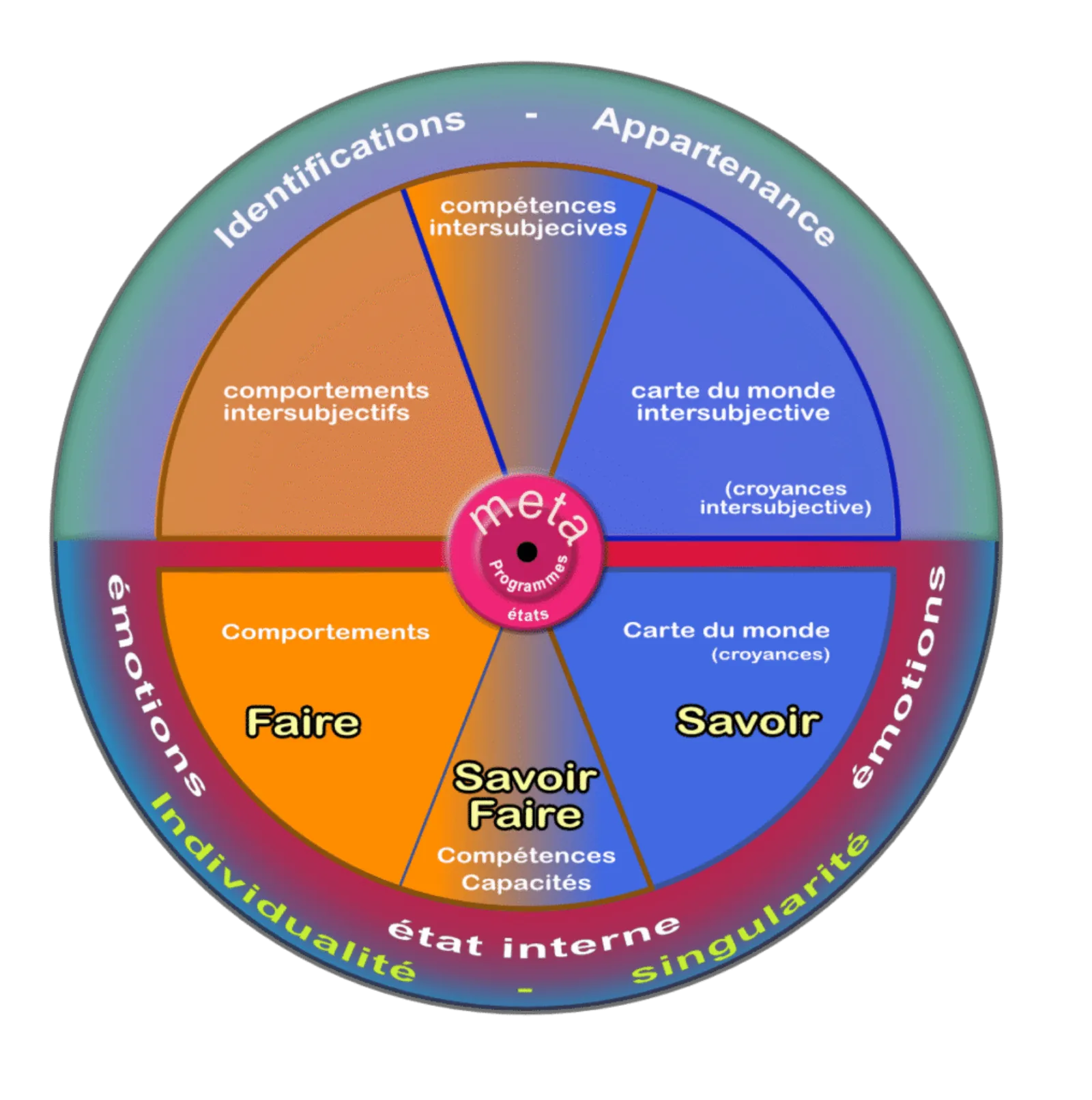
A circular, organic exploration
The Experience Matrix takes a different route, based on systemic exploration of the various spaces of experience with no imposed hierarchy.
A flexible starting point. Exploration can begin in any space, following what emerges naturally for the person.
Spaces to explore
- Context — current and desired life environments
- Behaviors — concrete actions and habits
- Skills — capabilities developed and still to develop
- Beliefs — convictions and representations of the world
- Emotions — affective states and their regulation
- Identifications — the groups, roles and models one identifies with
At the center: meta-programs — the personal filters for processing information, which orchestrate the whole.
The temporal dimension of identifications
The major innovation lies in treating identifications along three temporal dimensions.
Retrospective: “Which identifications from your past shaped who you are?” Present: “What do you identify with now?” Prospective: “Which identifications do you want to move toward?”
This recognizes that we evolve through successive identifications, and that defining a life project comes down, essentially, to choosing our future identifications.
What the matricial approach offers
1. Respect for human complexity
- no hierarchy imposed between dimensions
- circular interactions recognized
- contradictions and tensions integrated naturally
2. Grounding in the real
- identifications rest on concrete models
- the feasibility of projects gets examined
- incoherences surface organically
3. Flexibility of intervention
- adaptation to each meta-program profile
- the option to begin in any space
- respect for pace and for resistance
4. The social dimension built in
- identity recognized as fundamentally social
- inspiring models explored
- belonging groups taken into account
Toward a more coherent life project
The comparison shows that the logical levels offer a reassuring frame through their apparent simplicity, while their hierarchical rigidity and their theoretical malleability limit their effectiveness for something as complex as a life project.
The Experience Matrix, by recognizing the systemic and temporal nature of human experience from the outset, offers a frame more respectful of that complexity while keeping the practical rigor the work requires.
Working sheet: defining a life project with the Experience Matrix
Principle
A coherent life project emerges from the systemic exploration of the different spaces of experience and their interactions, with particular attention to temporal identifications and to the person’s meta-programs.
Step 1 — Exploring the central meta-programs
Aim: understand the personal operating system.
Key questions
- How do you generally process information? (global ↔ detail)
- Are you oriented toward process or toward results?
- Are your references internal or external?
- How do you perceive time? (in time ↔ through time)
Tool: a meta-program questionnaire adapted to life-project work.
Step 2 — Mapping current identifications
Aim: take stock of the identifications in play.
Dimensions to explore
- Professional: roles, occupations, sectors
- Personal: parent, friend, partner, and so on
- Social: belonging groups, communities
- Cultural: values, traditions, references
Questions
- Which groups and roles do you currently identify with?
- Which of your identifications are the strongest, the most important?
- Are any of them in tension or contradiction?
Step 3 — Retrospective exploration
Aim: understand the path of past identifications.
Questions
- Which identifications from your childhood or adolescence left a mark?
- Which models or heroes inspired you?
- Which identifications did you abandon, and why?
- What in your history makes sense today?
Tool: a timeline of identifications.
Step 4 — Prospective projection
Aim: explore the desired future identifications.
Questions
- Whose way of living their life do you admire?
- Who do you want to resemble in ten, twenty, thirty years?
- Which new identifications attract you?
- Which models of a life inspire you?
Step 5 — Systemic exploration of the other spaces
Principle: explore each space in relation to the prospective identifications.
Context
- Which environments would support these identifications?
- Which contextual changes are needed?
Behaviors
- Which behaviors characterize these identifications?
- Which concrete actions to adopt?
Skills
- Which capabilities to develop?
- Which learning to undertake?
Beliefs
- Which convictions support these identifications?
- Which limiting beliefs to transform?
Emotions
- Which emotional states to cultivate?
- How to handle the difficult emotions of change?
Step 6 — Synthesis and coherence
Aim: build an integrative view of the life project.
Questions
- How do these future identifications fit together?
- Is there temporal coherence across past, present and future?
- Which tensions remain to be resolved?
- What are the first concrete steps?
Step 7 — An evolving action plan
Principle: define flexible stages that respect the person’s meta-programs.
Elements
- priorities set according to the dominant meta-programs
- milestones adapted to how the person perceives time
- ways of tracking and adjusting
- the resources and support required
Complementary tools
- Genogram of identifications: a visual map of family and social identifications
- Coherence matrix: a table crossing identifications with spaces of experience
- Identification journal: tracking how identifications evolve over time
- Circle of models: the people who inspire, by area of life
Points to watch
- respect the natural pace of change
- don’t force artificial coherence
- treat resistance as information
- keep the project flexible
- recognize that multiple, evolving identifications are legitimate
This approach allows a life project to be defined that is anchored in the person’s actual reality while opening perspectives for change that are both authentic and achievable.