

The Actor and His Hundred Faces
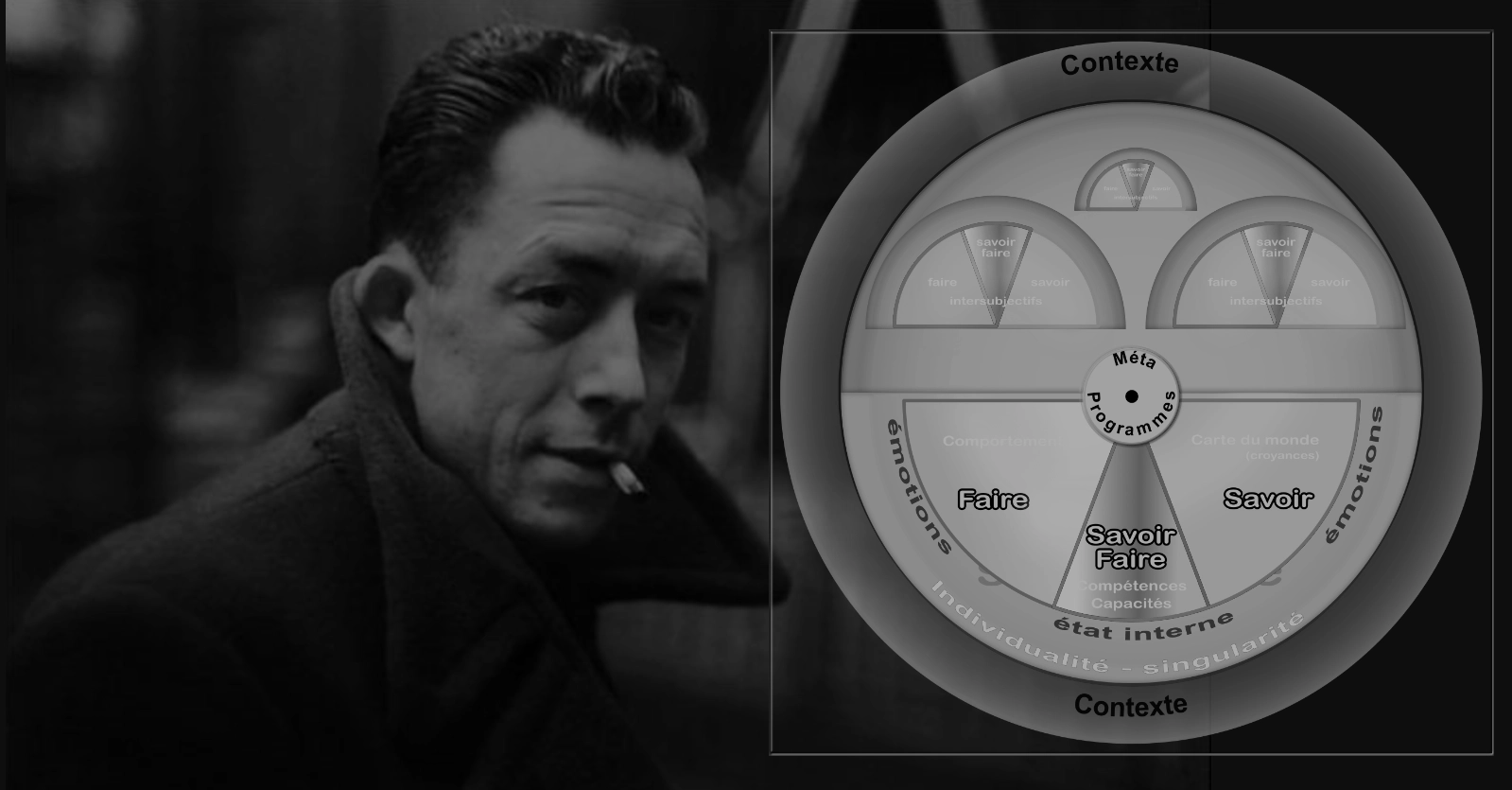
As NLP practitioners, we meet a question our clients keep bringing us: “Who am I really?”
The question is as old as thinking humanity, and it crosses ages and cultures.
Universal as it is, the answer stays out of reach.
In The Myth of Sisyphus, Albert Camus writes about the figure of the actor in a way that throws a striking light on our relationship to identity.
It is certain that, on the face of it, having seen the same actor a hundred times will not make me know him any better personally. Yet if I add up the heroes he has embodied, and if I say that I know him a little better at the hundredth character counted, one senses there is a measure of truth in it.1
Camus hands us a valuable key here. A person can be grasped in their shifting complexity through the prism of their multiple identifications, the roles they take on, the belongings they claim.
The actor is never entirely the characters he plays, and those characters are never entirely foreign to him either. Each role he interprets reveals a possible facet of his being, an expressive potential. In the same way, each of a person’s identifications, whether professional, cultural, familial or tied to what they love, discloses an aspect of their subjective experience without defining it in full.
That Camusian view invites us to reconsider how we handle identity in NLP practice.
Identity is less a fixed content than a container, a space that permits and welcomes various identifications without reducing itself to any of them.
When a client asks us to help them “find out who they really are,” we might instead invite them to explore their identifications: the groups they belong to, the roles they play, the models that inspire them, the archetypes that move them.
The approach offers a deep freedom. Rather than searching for a fixed and unchanging essence, it lets us recognize that we are not prisoners of a single definition of ourselves, but free to explore new ways of being, much as an actor can take on new characters without ever being reduced to one of them.
In NLP, this encourages us to support clients in exploring their multiple identifications and bringing them to awareness, recognizing the ones that limit them, cultivating the ones that nourish them, taking up new and enriching ones, and letting go of those that no longer serve.
The Experience Matrix, in this sense, turns out to be Camusian.
By replacing the traditional “logical levels” with something more fluid and more dynamic, it sets aside the notion of a fixed identity in favor of a space of multiple identifications.
That conceptual choice carries weight. It changes practice by freeing personal change from the constraints of a supposedly immutable identity. Identifications become levers of transformation, far more accessible and more malleable than the often intimidating fortress of “identity.”
Like the Camusian actor who finds his freedom in the multiplicity of his roles, our clients find theirs in the richness of their identifications. Not by looking for who they “really are,” but by actively exploring who they might become.
Footnotes
-
Albert Camus, The Myth of Sisyphus. Translated here from the French to preserve the figure of the actor, which Justin O’Brien’s standard English version renders as “a man”. ↩