

Identifications: The Relation and the Category
Introduction
When someone asks “Who are you?” and we answer “I am…”, we are usually not talking about our identity at all. We are listing our identifications. That distinction matters, because it changes what we think we are describing.
Identity is central to our existence, and yet answering “Who are you?” turns out to be a surprisingly difficult exercise, and a reliable source of confusion. What comes out spontaneously is not some deep identity but a series of identifications with categories of people we recognize and attach ourselves to.
Exploring those identifications shows how we build our relationship to the world and to others — and how the process of identifying becomes a powerful lever for change.
What an identification is
An identification is a relation. It connects an individual to a category of people who share common characteristics. Those categories go by many names: roles, occupations, religions, genders, language groups, nationalities, archetypes. Each name delimits a category through a set of characteristics — qualities, flaws, ways of thinking, ways of acting, skills.
What makes these categories particular is that they are not defined by the individual alone. They are broadly accepted, broadly understood, broadly recognized as such. There is a fundamental sociological dimension here.
How a category gets defined depends heavily on context — on the environment we are immersed in when we evaluate and delimit it. Cultural, sociological, linguistic and national parameters all shape the definition.
But one thing holds: these categories are widely understood by the group of people I am addressing when I invoke them. When I say “I am a doctor,” everyone understands that a doctor holds a certain degree, has certain skills, and acts in a certain way. That shared understanding is what lets me say “I am a doctor” and be understood.
The confusion around identity
The process of identification — this relation between an individual and a category of people — offers a different way of understanding what we normally call identity. At least, the identity we all invoke when we say who we are.
Identity is both an essential concept and a confusing one. Answering “Who are you?” is far more complex than it appears, and a major source of misunderstanding about ourselves and about others. Precisely for the reason just given: when we speak of identity, when we answer the question “who am I?”, we almost always answer with identifications with categories of people.
When I say “I am a creative person,” “I am a doctor,” “I am quick-tempered,” “I am Belgian,” “I am a man,” “I am a French speaker,” I am pointing to a category of people in which I recognize myself on certain characteristics. I am not describing who I am in my deepest singularity.
The confusion runs deeper still. We all know that this essential sense of identity appeals to something like a self-concept, which goes far beyond anything these identifications can express. At that point we start speaking of nature, of essence — and that notion of essence is itself open to discussion, as we will see.
So there are two distinct things wearing the same word. There is the identity that answers “who am I?” and draws on identifications. And there is the identity that belongs to my awareness of being myself, of recognizing and characterizing myself in my unique singularity. The terms are hard to choose here, because we slip from one to the other very quickly — which is exactly why identity needs more careful and more precise work than it usually gets.
The confusion has a practical cost: it makes us believe we know ourselves when we list our identifications, when all we have done is enumerate the social categories we attach ourselves to.
Working on the categories
Let’s return to the thread. When I answer “who am I?” by saying “I am…”, most of the time I am naming an identification. I am saying: I recognize myself as belonging to the category of people who have these characteristics.
Two points of action emerge from this. The first is the definition of the category itself — what we mean when we define a quick-tempered person, a Belgian, a French speaker, a Catholic, a Westerner, a warrior, a creative.
That definition can be worked on in two ways. There is the sociological definition, the shared meaning of the category. When I say I am a warrior, what does that mean concretely? Everyone holds a reasonably shared conception, with enormous variation around it.
And there is the definition as held by the person saying “I am a warrior.” That is an instance: a particular, individual, individualized definition. So we can work on two dimensions — the sociological definition and the individual one.
Both the individual and the collective definition depend on context: the sociological, cultural and religious environment in which the statement is made. Change the context and everything said takes on a different meaning, more or less accurate, more or less coherent with what that culture, that environment, that context defines.
There is a lever for change here, and in fact three: the lever acting on the individual definition of the category, the lever acting on its sociological definition, and the lever acting on the surrounding context.
Why context? Because a category depends on context not only for how it is defined but for how it is valued. Context supplies the definition and context supplies the evaluation. That is what makes an identification more or less comfortable to live with.
The identification relation
So much for categories. Now to the heart of the matter, which lies in the relation itself. An identification is a relation, created by the individual, connecting that person to a category of people — or giving them the sense of being connected to it.
That relation is a particularly effective and precise lever for change. It has parameters, modalities and submodalities that define its quality.
We can identify in time, at moments, not always. During the day I am a model employee; in the evening I am a father. We can also identify within a certain scope: the focal range within which the identification is operative.
Exactly as with submodality work in NLP, we can work the submodalities of the identification relation. “So you think of yourself as quick-tempered? Are you quick-tempered all the time, in every context?” In time, in space, depending on the setting, depending more broadly on context.
The second dimension is quality: how much the person likes or dislikes the identification relation itself.
In a given context, an identification relation is experienced as negative, unwanted or unpleasant if it leads me toward behaviors, a view of the world, or internal states — emotions — that I would call negative, or at least undesirable.
Conversely, the relation has a positive, agreeable quality when it leads me to see the world in a way that suits me, that lets me grow, that lets me perceive effectively, be in full possession of my resources, be in contact with my skills, and act on what is happening in my context in a way that produces the results I want.
Prototype theory
We can be more precise still. If I answer “who am I?” with “I am a creative person,” I am identifying with a category of people I qualify as creative — creative because they display creative behavior, because they have the know-how for creativity, and because they hold a view of the world: don’t settle for the usual way of seeing things, think outside the box. All the characteristics we might recognize in that category.
But these categories are not uniform, and here I draw on Eleanor Rosch’s prototype theory. When I look at the category of creative people, it contains many dimensions, many variations on creativity.
If the only creative person I can picture is Salvador Dalí, then at work, building my spreadsheet, I will feel like anything but a creative person. If Dalí is the figure in focus, I lose. But I can find other variations, far more accessible, far closer to what I actually live. That is prototype theory.
The prototype is the typical exemplar of the category. We each choose a different one. The prototype works like the center of a circle: within the category, some people will seem far from it and others close to it. And that gives us an additional intervention tool, since the category is defined by certain ways of acting (behaviors), certain ways of seeing the world (the map of the world), and certain know-how.
We choose our prototype individually, and each choice carries its own qualities and its own modalities.
Picture a category of identification — a category of people — as a set, a large surface, a wide circle. Each person can pick their own prototype, the person most representative of that category for them. It is as if each of us hooked on at a different point.
In other words, the way you identify with a category that everyone recognizes varies with the prototype you choose. A painter may identify with Salvador Dalí as their prototype of the creative; you may identify with the creative who writes the most elegant macro possible for their spreadsheet.
Depending on the prototype you choose, your way of approaching and evaluating that category of people can vary enormously. The category of creative people takes on a different color depending on the prototype, and that choice is eminently subjective — bound to your singularity.
The levers for change
That gives us one more lever. Let’s summarize the whole set:
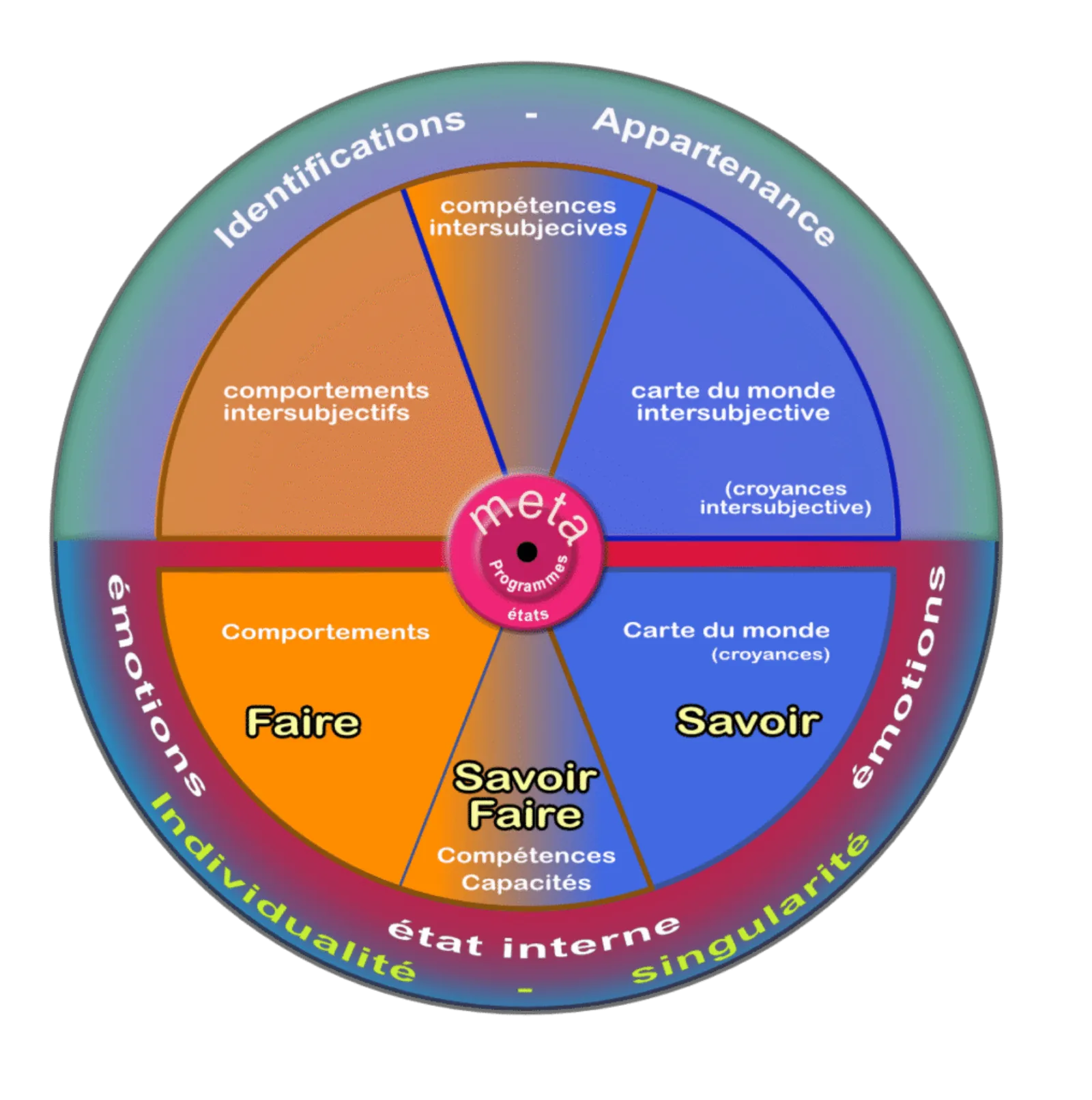
1. The lever on the category of people the person connects to through the identification relation. The category is defined by a set of qualities, which we can sort into behaviors, view of the world (beliefs and values), and know-how (skills). Someone in this category behaves in this way, has these skills, and holds this map of the world — a set of beliefs and values that matter.
2. The lever on the relation itself — the link binding me, as a person, to that category of people. The link depends on scope: the frame within which the relation operates. A time frame: morning, evening, at work, at home. A context frame: place, at work, at home. And a set of further parameters: when I am tired, when I am rested. A whole set of conditions that determine whether the relation activates or not.
3. The lever on the choice of prototype — which prototype you have selected within the category that everyone recognizes.
the Identifications space
One last distinction may be useful: the range of identification categories available to me, within reach.
Consider “I am an athlete” and “I am a warrior.” They are distinct, but they sit relatively close. The fighter and the warrior both fight. The athlete also fights, for the win.
Take another category, though — “the father” — and it sits far enough from certain others to make adaptation and passage between them difficult.
So we can construct a Identifications space, in which some identifications are closer to one another than others, and proximity makes change easier.
Something else worth noting: within my singularity, identifying with a given category of people activates parts of myself. I can be identified at once as a good father, a writer, a creative, a warrior, even a magician.
Each of these activates within me, by resonance, something like mirror neurons — the parts of me that make available a certain range of behaviors, skills and ways of seeing the world. There is a mirroring effect here. Mirror identification, if you prefer.
What this looks like in practice
When I ask someone “What are you?” and they answer “I am…”, they are giving me, in the great majority of cases, an identification. They are defining a category of people, and from there I can begin to explore.
What do you mean by that category? How do you define it in terms of behavior, skills and view of the world?
Then I can turn to the prototype the person has chosen. They will tell me, more or less consciously, or I can ask.
And finally I can question the identification relation itself: how the person lives it.
The scope, in space, in time, in the cultural and sociological context, whatever the frame may be. And the quality: how it is valued — desirable, wanted, unwanted.
For each of these parameters there is also a question of intensity. Strongly wanted, or fine as it is, or strongly rejected, or simply tolerable and lived with.