

Borrowed Desires: Girard and the Identifications Space
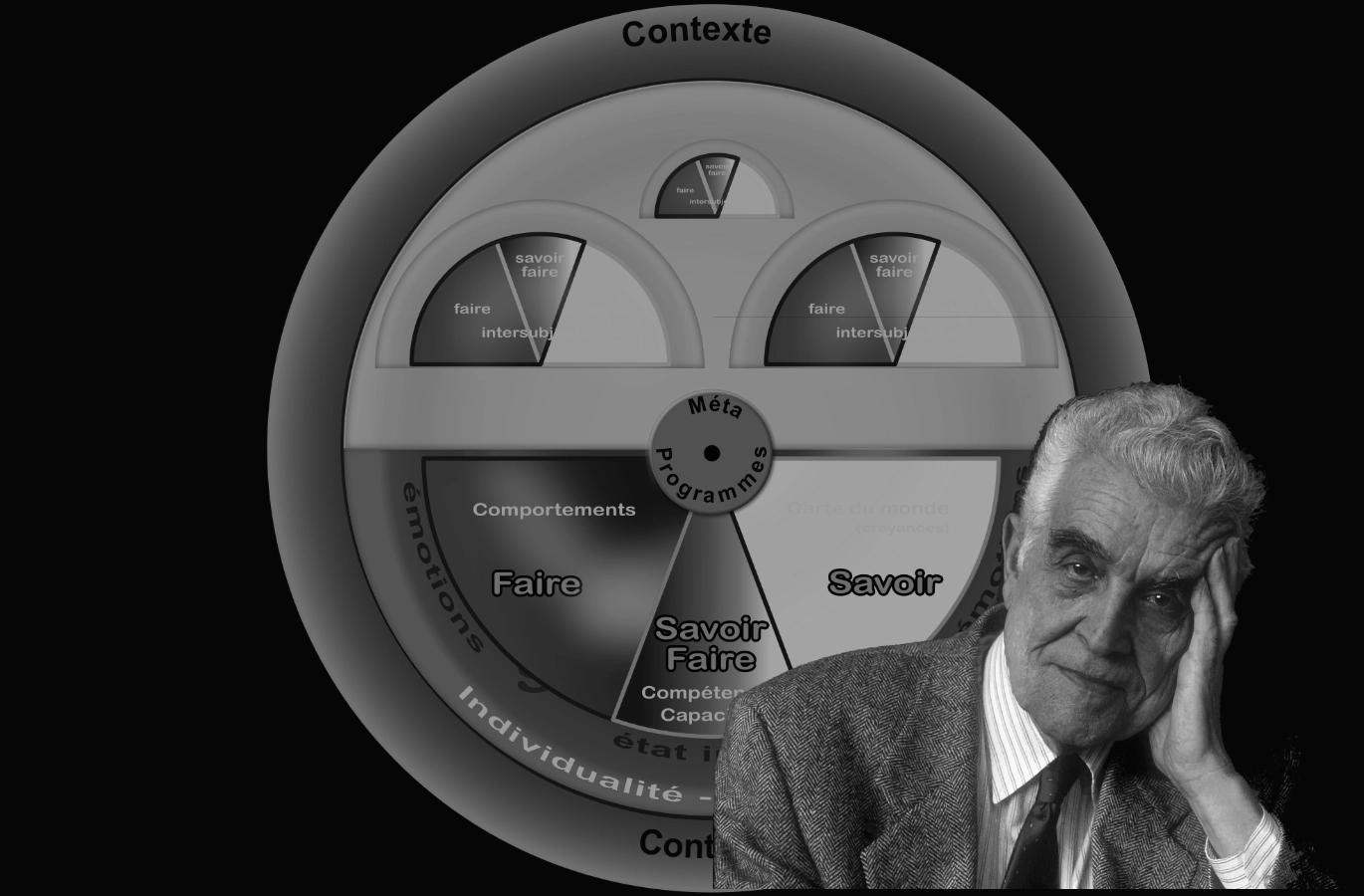
The Experience Matrix extends the NLP logical levels, and it gives a more dynamic and more interconnected picture of how we relate to the world.
One of its most fertile dimensions is the Identifications space, which runs strikingly parallel to the theory of mimetic desire developed by René Girard, the French literary critic and anthropologist.
Identification, in the Experience Matrix, means that we define ourselves largely through our relation to others, identifying with classes of people whose emblematic behaviors and collective worldview we take up. That resonates with Girard’s core insight: our desires are not autonomous but borrowed from models we imitate.
Girard shows that human desire is triangular. It involves a subject who desires, a model who is imitated, and an object that is coveted.
The same ternary structure appears in the Experience Matrix: the individual (subject), the class of people they identify with (model), and the attributes desired (emblematic behaviors and worldview), which may also include professional goals, coveted social positions, or any object that stands for success in a given setting.
the Identifications space captures precisely this mechanism by which we forge an identity through imitating others.
For Girard, mimetic desire moves from simple acquisitive desire, wanting to possess what the other possesses, toward a deeper metaphysical desire, wanting to be like the other. That distinction sheds light on the different degrees of identification observable in the Matrix. Sometimes we adopt no more than a group’s observable behaviors (the acquisitive level); at other moments we absorb their worldview, their values and their way of being (the metaphysical level).
Identification runs two ways in the Experience Matrix, and that has its echo in Girard as well. Just as Girard shows the model becoming the imitator of his own imitator in a mounting reciprocity, the Matrix holds that I identify with the group and the group recognizes me, or does not, as one of its own. That can generate productive tension.
Mimetic rivalry, central to Girard, helps make sense of certain difficult dynamics in the Identifications space. When two people desire the same social position, the same status or the same recognition through mutual imitation, conflict can emerge. The Experience Matrix lets us spot those situations and open paths for change by helping people recognize the unconscious identifications feeding the rivalry.
Where Girard sees mimetic desire as a potential source of violence requiring cultural mechanisms of regulation, the Experience Matrix offers a practical way to transform those dynamics. It proposes conscious work on our identifications. Which of them limit us? Which enrich us? How might we identify more consciously and more constructively?
The convergence between Girard’s theory and the Experience Matrix is not merely theoretical. It invites us to examine our identifications clearly, to recognize how mimetic they are, and to develop a more conscious and more autonomous relationship with our models and our desires. It reminds us that our identity is never entirely “ours” but always woven from multiple influences and identifications.
Bringing that mimetic perspective into work with the Experience Matrix gives NLP practitioners and coaches a solid instrument for supporting clients in exploring and transforming their Identifications space. It affords a better grasp of the deep mechanisms shaping how we relate to the world, and it opens a road toward an authenticity that runs, paradoxically, through the clear-eyed recognition of how imitative and how relational we fundamentally are.